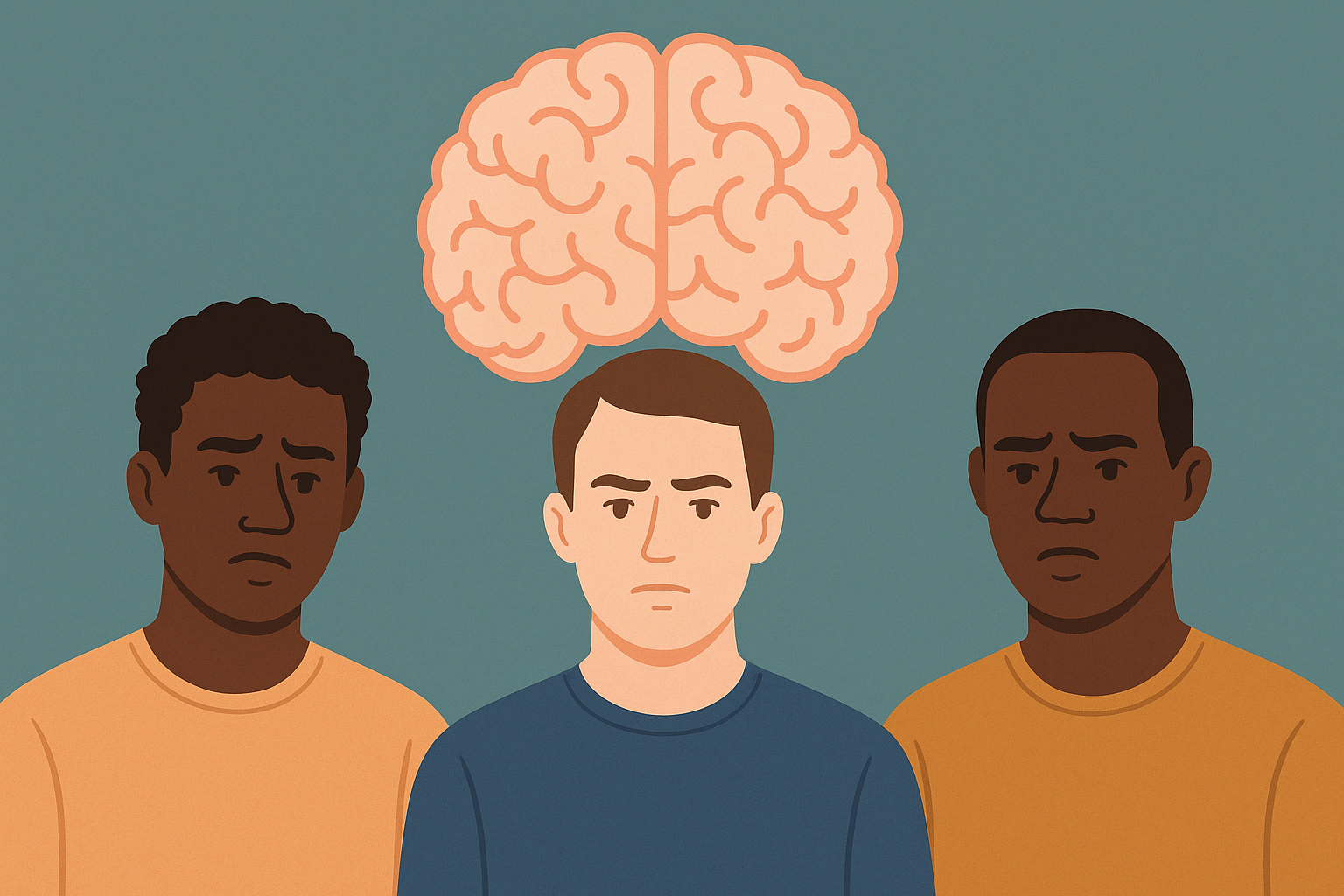

What is the Invisible Gorilla Experiment?
Do you believe you always notice what happens around you? The famous Invisible Gorilla Experiment proved that our attention is far more limited than we imagine.
In 1999, psychologists Christopher Chabris and Daniel Simons asked participants to watch a short video of two basketball teams passing the ball and to count how many passes the players in white made. While everyone focused on the ball, something unexpected happened: a person in a gorilla suit walked right through the scene, beat their chest, and left.
The surprising result? Nearly half of the participants didn’t notice the gorilla at all. They looked directly at it, yet their brain simply filtered it out.
This phenomenon is called inattentional blindness: when we concentrate so hard on one task that we fail to see what is right in front of us.
Everyday Examples of Inattentional Blindness
This isn’t just an isolated experiment; it happens in everyday life:
- A driver doesn’t see a cyclist while checking the traffic light.
- You look for your keys everywhere, even though they’re right in front of you.
- Someone is talking to you, but you’re so absorbed in your phone that you don’t process what they said.
The invisible gorilla reminds us that our brain selects what to pay attention to, and in that process, many details disappear.
Why Does the Brain Ignore the Obvious?
Our attention works like a spotlight: it illuminates one thing clearly but leaves the rest in the shadows. This helps us focus and survive in complex environments, but it also means we miss a lot more than we realize.
What’s most fascinating is that people are often convinced they “would have seen the gorilla.” But research shows that the more confident we are in our perception, the more likely we are to be tricked by our brain.
The Invisible Gorillas in Your Life
Think about it: what “invisible gorillas” might you be missing right now?
- An opportunity because you’re too focused on your worries.
- A moment of connection with someone close while your mind is elsewhere.
- A simple solution to a problem you can’t solve because you’re fixated on the wrong detail.
Recognizing our cognitive limits doesn’t make us weaker; it makes us more aware and opens the door to better decision-making.
Final Reflection
The Invisible Gorilla Experiment shows us that reality is never captured in full, but filtered by our attention. Understanding this helps us be more humble with our perception and more alert to what might be escaping us.
Next time you’re sure you’ve seen it all, remember: there may be a gorilla crossing your path… and your brain might be ignoring it.
👉 On our YouTube channel, PsyLife, you’ll find a complete and visual video about the Invisible Gorilla Experiment, with practical examples to help you understand how your attention works and how to spot what you usually miss.