
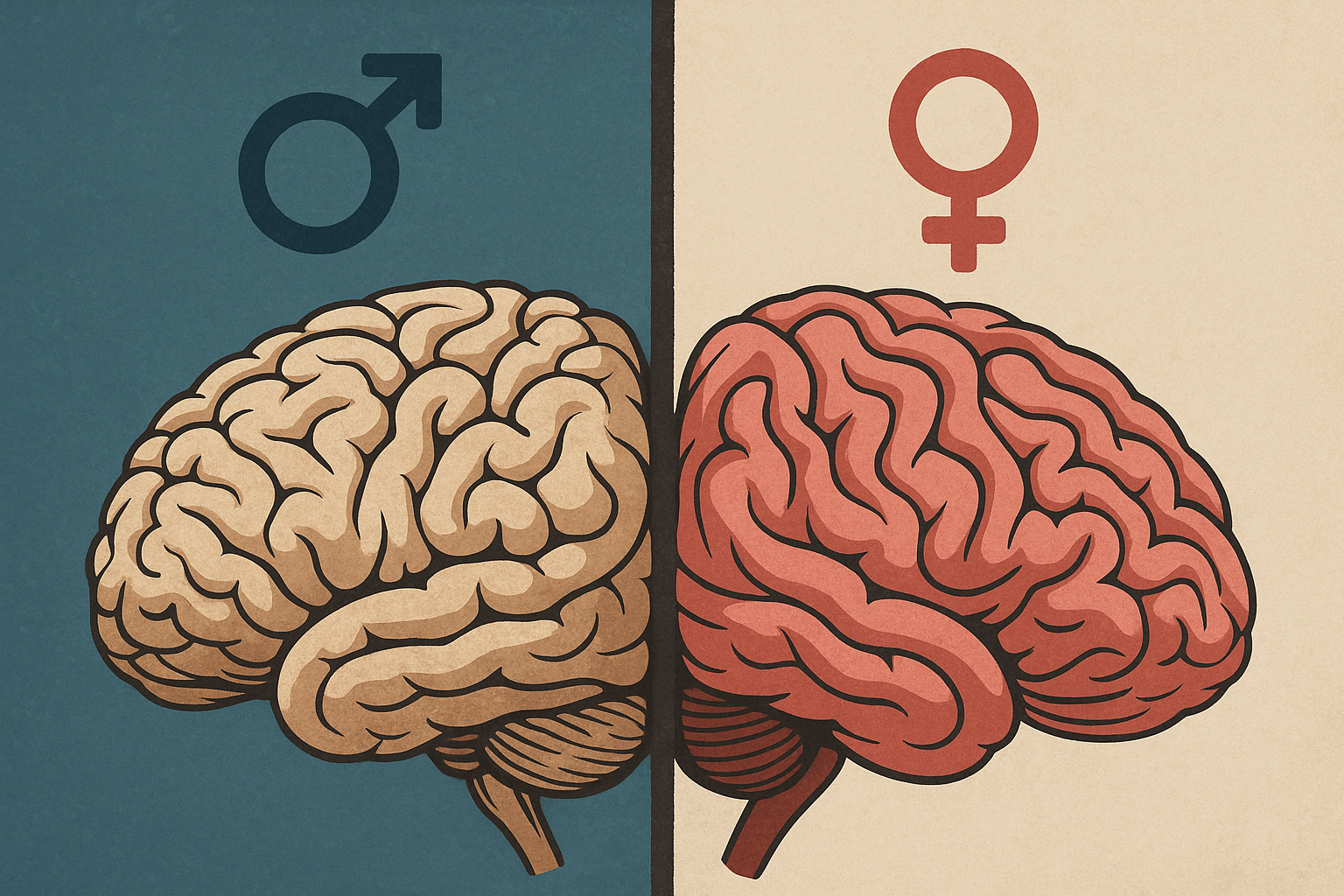
Are there real differences between male and female brains, or is it just a myth we’ve carried for centuries?
For a long time, people tried to explain gender differences through biology. But modern neuroscience tells a very different story — one that’s far more complex, and much more equal, than we used to think.
The Origins of the Myth: When Size Meant Everything
In the 19th century, some scientists claimed that women were less intelligent because their brains were smaller.
Today, we know that this idea has no scientific basis.
Brain size does not determine intelligence. Einstein, for instance, had a smaller-than-average brain, yet his genius remains unquestionable.
This obsession with measuring brain volume led to decades of false conclusions, mixing biology with social prejudice.
What Modern Neuroscience Says About the Male and Female Brain
Advances in neuroimaging have made it possible to observe subtle differences between male and female brains — but not in terms of superiority.
Some studies suggest that:
- On average, men have a slightly larger brain volume.
- Women show greater connectivity between hemispheres and higher neuronal density in areas related to memory and emotion.
However, these differences are small and do not determine intelligence or cognitive ability.
In fact, more than 90% of brain structure is identical in both sexes.
The Real Causes: Experience, Culture, and Brain Plasticity
Current neuroscience focuses on something far more important than gender: brain plasticity.
The brain changes and adapts according to experience, education, and cultural environment.
That means many differences attributed to sex are, in reality, the result of socialization.
Example:
If boys are encouraged to play with spatial or construction toys, they tend to develop better spatial skills.
If girls are encouraged to communicate and empathize, they tend to improve emotional recognition.
Culture shapes the brain as much as biology does.
Intelligence, Emotions, and Skills: Who Excels at What?
Studies show small tendencies, not universal rules.
Spatial orientation and mental rotation are often better in men, but can improve with training.
Verbal memory and emotional recognition are often higher in women, but can also be trained.
The key point is that individual differences far outweigh gender differences.
In other words, there’s more variability between two random men or two random women than between the average man and woman.
Beyond Gender: What Really Makes Us Different
Science is increasingly reaching a clear conclusion: the human brain is not binary, but a mosaic.
Each person has a unique combination of traits, connections, and abilities that don’t fit neatly into “male” or “female” categories.
We are, above all, the result of an interaction between genes, environment, and experience.
Understanding this not only dismantles old prejudices but also opens the door to a more free and diverse view of human intelligence.
Final Reflection: More Alike Than We Think
The male and female brain are not opposites, but variations of the same human design.
The real differences are not biological, but in how each person learns, feels, and relates to the world.
Recognizing this helps us value diversity and focus on what truly makes us human.
👉 On our YouTube channel, PsyLife, you’ll find a clear and visual video about the differences between male and female brains — and what modern neuroscience really says about them.
💬 Tell us in the comments: Do you believe men and women think very differently, or are we more alike than we imagine?